
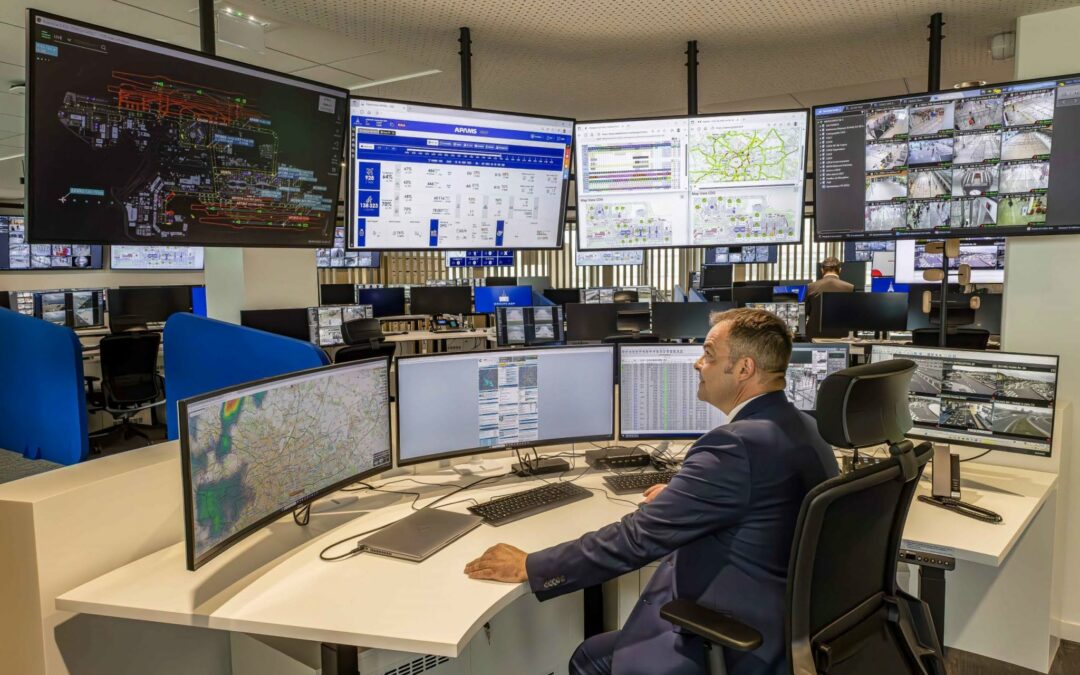
In an increasingly demanding airport environment, this operations center, also known as APOC (Airport Operations Center), is becoming an essential coordination tool. By bringing together the main stakeholders of an airport platform around shared real-time information, this center improves responsiveness, flow, and service quality. For ground handling, it also provides a framework that highlights our expertise and strengthens our role in collective performance.
In practical terms, an AirPort Operations Center brings together in one place representatives of the main players involved in running an airport: the airport operator, airlines, ground handlers, air traffic control, and others. Equipped with monitoring screens and communication tools linked to the airport’s operational teams, it provides a shared view of ongoing operations and enables fast, coordinated decision-making. The goal? To improve the airport’s overall operational performance, particularly during disruptions or operational incidents.
Moving from fragmented operations to a common approach
These airport operations centers address a simple need: better coordination of airport operations in an environment that has become more complex. Today, operational quality no longer depends solely on the performance of each player taken individually, but on their ability to work within a common framework, with better-synchronized decisions.
That is precisely the purpose of these APOCs: to serve as a true governance framework by bringing different functions closer together, streamlining exchanges, and providing a consolidated view of the operational situation. This way of working makes it possible to anticipate the effects of a disruption earlier and to act with greater consistency. The aim is therefore not to centralize decisions, but to coordinate them better.
Cooperation that benefits the entire airport platform
This collaborative approach brings tangible benefits to all members of the airport community.
For airport operators, it encourages better use of infrastructure, smoother resource management, and a greater ability to cope with disrupted situations.
Airlines also have a direct interest in it. Better coordination helps reduce delays, secure turnaround times, and improve the regularity of operations, with positive effects on both service quality and operating costs.
For all players in the broader handling sector, coordination reduces operational friction and “surprises.” Fewer last-minute changes, fewer conflicting decisions, and more consistency in prioritization mean more stable performance and more robust service quality.
For ground handlers: better anticipation, better execution, greater responsiveness
Ground handling is, in fact, driven by minutes won or lost. In this context, the contribution of these operations centers is very concrete: earlier and more reliable shared information makes it possible to adjust resources at the right time, resequencing certain tasks, and coordinate interfaces more effectively (airline, airside, terminal, baggage, technical service providers).
But the challenge is not only informational. Ground handlers no longer simply “deal with” decisions: they help assess feasibility, provide objective processing times, identify weak points, and propose realistic solutions.
Examples in France: momentum already underway
Several French airports are already engaged in this collaborative management approach.
- At Paris-Orly, the deployment of an APOC illustrates the growing importance of stronger coordination among stakeholders in order to improve real-time management and decision-making in disrupted situations.
- At Nice Côte d’Azur, the implementation of an Airport Operations Center reflects the desire to continuously share a common operational picture and speed up arbitration.
- At Marseille Provence, the drive to bring operational functions together is moving in the same direction: improving responsiveness and coordination in support of operational regularity.
These initiatives confirm an underlying trend: faced with the growing complexity of operations, the competitiveness of an airport platform is also built on its ability to get key stakeholders working together within a shared framework.
For the promises of these operations centers to be fulfilled, it is essential that ground operations professions have their full place within them, with structured exchanges and a shared understanding of constraints.
This is the CSAE’s approach: taking all airport stakeholders into account is not just good practice; it is a performance lever.
To stay up to date with our latest news and projects :
